

A while back, I came home from work upset, hair disheveled, and burned out.
I knew what burnout was and that it would pass, but I was curious if every marketing job constantly left you on edge at work and mentally exhausted after. I was even more curious if the feeling I was experiencing was simply work. I wondered if it was my particular job that was stressing me out, if the marketing field was not for me, or if I was being a lazy Gen Z-er, who believed work shouldn’t be stressful or difficult.
So, I sat down and thought of friends who work in similar industries. One of my friends works for a large company and I asked him for help.
“I can write a six-page paper on the topic,” he replied to my rant.
After our conversation, I quickly jotted down everything I learned.
First off, the nature of the marketing field is grueling. Companies will demand your time, energy, and talents.
Second, welcome to the real world, where you work until you retire somewhere pretty and (hopefully) far away.
Third, I wasn’t actually lazy. I’m just the type of person who cares so much about the quality of the work they put out, that I let perfection eat me alive.
This third realization blew my mind because I realized I was expecting perfection out of all my tasks at work. On days when I would accomplish everything in a timely fashion, I’d keep ruminating on one project that wasn’t as good. I would get mad at myself. “How come all of it isn’t perfect?” I asked.
“Don’t let perfect be the enemy of the good,” my friend said.
A few days later, I read this piece about the 70-20-10 method, which opened my eyes and showed me I was doing “work” all wrong.
It’s actually quite simple: accept that 70% of the work you produce will be mediocre, 20% will suck, and 10% will be amazing.
A sticky note on my monitor with this method reminds me every morning how work cannot be about perfection. Sometimes, we just need to zoom through it and get the job done.
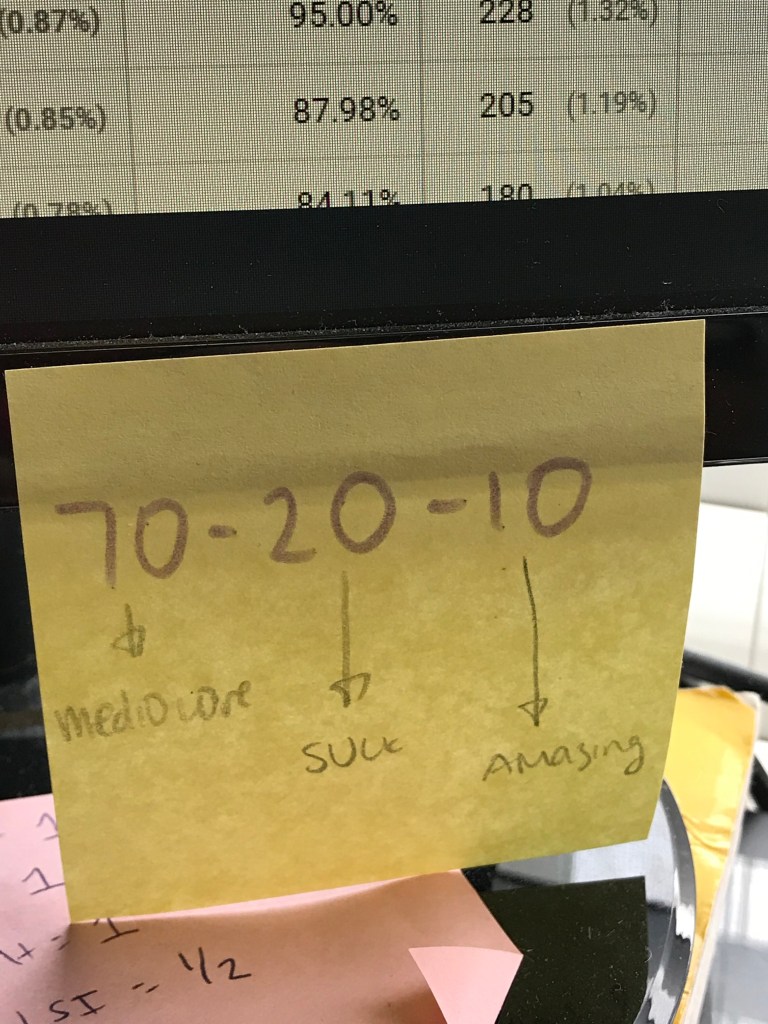
My workflow mantra!
A study about a ceramics class showed students who strived for perfection produced the worst work compared to peers that aimed to produce the most amount of work. “It seems that while the “quantity” group was busily churning out piles of work – and learning from their mistakes — the “quality” group had sat theorizing about perfection, and in the end had little more to show for their efforts than grandiose theories and a pile of dead clay,” researchers said.
I’ve been practicing this method ever since and I’m finally getting the hang of it.
Yes, sometimes I get bummed that my product descriptions are missing an enticing zing, but hey. It’s worth it! When I get to shut off my monitor at the end of the day, I trust that I did my best and that a sliver of my workday was in fact, amazing.
Do you have any workflow tips? Let me know in the comments down below!
 torimuser
❤
LikeLiked by 1 person
A mantra! I need to find a mantra
LikeLiked by 1 person
it could be anything! it doesn’t have to be overly complex. 🙂
LikeLike
Love this post and relate a lot to it. It’s hard and important to have sharp and well defined boundaries, and a completely unrelated outlet. (I draw/ sing/study languages)
LikeLike